As a key component of the central dogma of molecular biology, RNA is not only directly involved in protein synthesis but also precisely regulates gene expression at both transcriptional and post-transcriptional levels. Beyond the sequence itself, the spatiotemporal distribution of RNA molecules is intimately linked to their function and regulatory mechanisms, making it essential for deciphering cellular functions and operational modes. Within a cell, a single gene typically produces multiple RNA copies, each exhibiting high heterogeneity due to differences in cellular localization and molecular interactions. Thus, developing live-cell imaging methods with single-molecule resolution to observe the dynamic activity of endogenous RNA has become an urgent need in the field.
However, existing imaging technologies face significant bottlenecks. While traditional MS2 repeat sequence labeling allows for single-molecule tracking, the introduction of exogenous sequences can easily interfere with the RNA's natural physiological state. In addition, previous CRISPR-based RNA imaging or molecular beacons can label endogenous RNA but are often limited to repetitive sequences or RNA aggregates. These limitations have long hindered progress in live-cell RNA research. Until now, labeling and tracking the movement of non-repetitive endogenous RNA at single-molecule resolution has remained a challenge.
The smLiveFISH technology, led by Assistant Professor Chenglong Xia at the Fudan SANS Neuroscience Center, overcomes these hurdles by leveraging the RNA-targeting CRISPR-Csm system. This system integrates the ability to process crRNA arrays with an inherent natural signal amplification capability. By designing an array of 24–48 crRNAs targeting a specific RNA, paired with multi-fluorescently labeled Csm proteins (each complex carrying ≥3 GFP tags), the technology successfully overcomes the signal-to-noise ratio limitations of traditional RNA CRISPR imaging. This approach enables the direct observation of endogenous RNA dynamics in live cells at the single-molecule level for the first time.
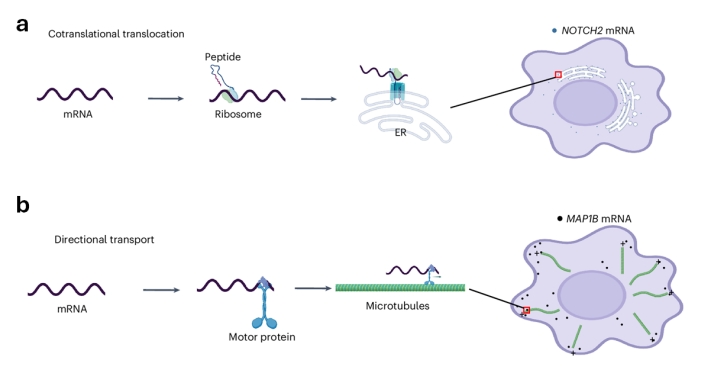
Using this technology, the research team not only validated the classical theory of NOTCH2 mRNA anchoring to the endoplasmic reticulum via cotranslational translocation but also directly observed changes in its movement patterns upon pharmacological translation inhibition. Furthermore, through real-time observation of MAP1B RNA movements, the team captured MAP1B mRNA’s directed transport along microtubules, providing a direct mechanistic explanation for its enrichment at the cell periphery. The study also revealed that when translation is inhibited by puromycin, MAP1B mRNA co-localized with P-bodies. These discoveries offer new possibilities for evaluating pharmacokinetics at the single-molecule level and enhancing the efficiency of drug development and precision medicine.
Through the precise tracking of endogenous RNA motility, smLiveFISH offers significant potential for understanding complex biological processes. The technology is poised to be transformative in neuroscience and RNA cell biology, where it can monitor mRNA transport kinetics and stepwise displacement in neurons with unprecedented sensitivity. Such capabilities potentially provide essential dynamic pathological insights into RBP-mutation-driven disorders, including FXS and ALS. Furthermore, the integration of orthogonal Type III CRISPR-Cas systems will facilitate the exploration of RNA-RNA interactions, splicing, and cotranslational protein complex assembly. Ultimately, these advancements will accelerate the study of RNA spatiotemporal dynamics and establish a high-precision platform for single-molecule evaluation in drug discovery and precision medicine.
This work was published in Nature Biotechnology and has been highlighted by prestigious journals such as Nature Methods (https://www.nature.com/articles/s41592-025-02672-9) and Nature Biotechnology (https://www.nature.com/articles/s41587-025-02560-9). The first author is Chenglong Xia. The Xia Laboratory is dedicated to the long-term development and application of macromolecular imaging, spatial transcriptomics, and gene editing tools. Scientists interested in these fields are welcome to get in touch for potential collaboration.
Link to original paper: Single-molecule live-cell RNA imaging with CRISPR–Csm | Nature Biotechnology






 浏览量:
浏览量:
 TOP
TOP